

I hope everyone has had a restorative and restful Thanksgiving Break. As I have been on my resilience tour these past few months (see previous post here), you should know that I take personal rest and societal withdrawal very seriously. In fact, and even to my surprise, I did exceptionally minimum work on our mini-vacation from school (thankfully, I had the whole week off), with the exception of packing a few boxes ahead of our move.
In the interim, I rewatched Downton Abbey (it’s on Peacock! Fabulous series if you enjoy period pieces). However, for a split second, I started to feel antsy about too MUCH relaxation, and the unending list of tasks I could easily tackle before next week. Plans such as putting the finishing touches on lesson plans, or uploading new teaching materials to Teaching Spanish Made Easy. I wasn’t lured back into working when my body clamored for a pause because the truth is, I ver much needed the rest.
Spanish I Mini-research project
Now, that I am getting back in the saddle, I wanted to share this lesson I did with students prior to Thanksgiving Break. They did a research project in Spanish with an added a twist; they could integrate AI for SOME of the components. This project was done on the heels of our Hispanic Heritage unit, which tied together vocabulary and structures needed for discussing various aspects of one’s identity, professions, personality traits, and hobbies. The project itself was both a huge hit and a sanity saver for a myriad of reasons:
Reason #1: It yielded dividends across the spectrum. Students sharpened their language and critical thinking skills, and I had less to manage in terms of off-task behaviors. Additionally, the inquiry-based learning component was overall empowering for my Spanish level I students.
Reason # 2: Students thoroughly enjoyed collaborating and presenting together. Not everyone choose a partner, but those who did work well in tandem. These young scholars commanded the room as they presented without relying heavily with reading from every slide (which was baked into the rubric).
Reason #3: After modeling how to conduct research in Spanish and English, I stepped back and became a facilitator, making this assignment mostly student directed.
Below is a breakdown of the project:
We prioritized using/recycling vocabulary and structures from previous units:
- Country’s capital and touristic cities (verb ser)
- The population (haber & numbers)
- Colors of the flag (ser and colors); some students research the meaning of flag and that was an added bonus!
- Famous person: we started with 2, but due to time constraints, I had them only include one
- Popular foods and exports (the usual)
Modeling What You Want
- To start us off, I presented on a Spanish-speaking country , so students would have a clear model and felt comfortable doing this activity in Spanish on their own; I also modeled how to use AI for certain parts of the project.
- Notice on the slide below they include very basic information. When I model how to talk about the colors of the flag, I asked questions such as : “would I say los colores es blanco, azul y amarilla” And the students corrected me. I did this while presenting information so that they would understand the uses of single and plural verbs such as: es/son and gusta/gustan.

Students had to include products or exports of the country. For this section, I showed them how to look up the information in Spanish. We used the AI Overview in Google, which is surprisingly comprehensible. I use this method in upper-level classes as well. Using the projector, I searched “Los productos populares de Argentina” and instructed students to do the same with their respective countries. We then went through the products, and I read the overview and asked questions such as what do you think “soja is” what are “productos de consumo masivo.” I also endorse the the 80/20 method; focus on the 80% of what you can understand. They got mostly all of it.
See the example below (the are allowed to look up words they don’t know, but we use lots of context clues to narrow down which ones are worth looking up).


Students then researched a famous person. For this, they had to include the following:
- Name of the person (llamarse)
- Age of the person using (tener)
- List 3 personal characteristics (ser + adjectives)
- List 3 things they like to do (gustar+ infinitive verbs)
- List 3 things they don’t enjoy (gustar+ infinitive verbs)
- List 2 achievements (for this they could use AI)
To learn more about the famous person, they read about them in English first, and then wrote in Spanish. For likes and dislikes, I instructed them to surmise from the information available what they’d like or dislike; we did the same for personality traits. In other words, if a person was a writer, we could safely assume they liked to read, write, journal, etc.

For the last part of the project, I allowed them to use AI- with the caveat that they could only write down what was mostly comprehensible (they were allowed to look up a few words). This was key, as I heard partners reading, interpreting and negotiating meaning.

Presentation to Class
The gran finale (and we’re still not done. Students present the last 20 minutes of class so we don’t spend the whole class doing presentations). I used a very simple rubric that we discuss during class and I write on the board. They were graded based on the categories below (each 5 points)
- Delivery (this included not reading off the screen and establishing eye contact with classmates. They also had to thank the class in Spanish- yes, this was part of the grade)
- Pronunciation (clear and comprehensible pronunciation)
- Collaboration (if students appeared not to know who’s turn was next, or stalled, I took off points. They had class time to practice and make it as organized as possible)
- Content (students included all the parts in their presentation; this was crucial for the students who like to purposely and ignorantly anglicize some Spanish words to be funny)
- Creativity (the presentations were crafted thoughtfully, and reflected the time and direction provided in class).
I hope this inspired ways to use inquiry-based learning coupled with AI in your class! Check out our holiday-themed resources below!


- Holiday Traditions in Equatorial Guinea: Spanish-speaking Country in Africa
- New Year’s Story: New Beginnings (Preterite Tense)
- La maleta: Holiday Traditions in South America
- New Year’s Activity: No te metas con mis metas
- La noche de las velitas (Colombia)
Comprehensible Novels for the Classroom
“Kick back and let acquisition do its work!”
Discover the perfect novel for any classroom with our extensive library, tailored for every level and interest. Each book comes with proven teaching materials designed to captivate students through engaging storylines, language use, authentic expressions, and essential grammar structures. Empower your teaching and keep your focus where it matters most: on your students’ learning!


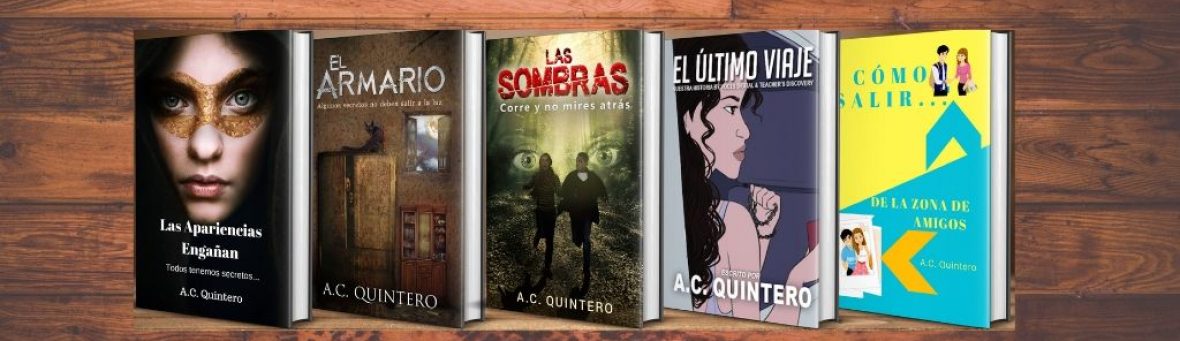
Novels and Resources by A.C. Quintero

A.C. Quintero Literary Partners!
Brycehedsrom.com
Command Performance Language Institute
Wayside Publishing
Teacher’s Discovery
The CI Bookshop (Europe)

Teaching Spanish Made Easy (TPT) Catalog

Join Our Facebook Community “Teaching From the Trenches!”
Facebook https://www.facebook.com/groups/993395751183802/
Stay Sharp—Don’t Miss a Video!
You tube https://www.youtube.com/channel